Understanding Gauge
If my stitches are really tight, say 6 sc to cover an inch, and yours are really loose, say 3 sc to cover an inch,
and we are both crocheting a pattern that calls for 12 sc, my piece will be 2 inches long, but yours will end up 4 inches long.
If we're both crocheting socks for the same person, mine may end up too tight and yours too loose.
Most patterns suggest measuring your gauge with the yarn, hook and stitch you will use for the project. If your
gauge is off, they suggest making your stitches tighter or looser.
On this site, your gauge is your gauge. The pattern adjusts automatically to adjust for YOUR crochet style. It is super important
to crochet a gauge swatch before generating a pattern for your project.
- Using the same hook you will use for most of your project, chain 25
- Turn and then use the same stitch (stX) you will use for most of your project to crochet back to the first chain (24)
- – X. *Chain 1, turn and stX to the end* Keeping count of the rows, repeat * * until the swatch is a little more than 4” tall.
- (optional) Wash and dry the swatch (some yarns do not shrink with washing and air drying. If your unfamiliar with the yarn, wash the swatch before measuring for gauge).
- Splay out the swatch without stretching it and measure it in two dimensions to the nearest 1/8 inch
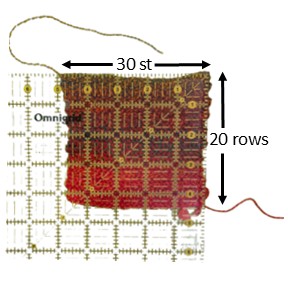
30 st spans 4 7/8in. 30/4.875 = 6.2 st/row (round to 6 st/row)
20 rows span 4 1/2in. 20/4.5 = 4.4 rows/in (round to 4 rows/in)
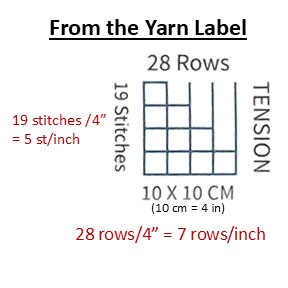
Alternatively, you can enter gauge from the yarn label